
In this guide to Primary 3 composition feelings, thoughts and speech, we will look at how these details can deepen the main event. In the previous article, we explored how to develop the action. Now, let’s see how a character’s feelings, thoughts and words can make the same scene more engaging. When developing a Primary 3 composition with feelings, thoughts and speech, choose details that fit the event and connect naturally to the character’s actions.
To make the main event more interesting, pupils can also show what the character feels, thinks and says. These details help readers understand the character’s reaction and make the scene feel more complete.
How to write the main character’s feelings, thoughts and speech
1. Show the character’s feelings
There are two ways to describe a character’s feelings: tell the feeling directly or show it through the character’s actions and body language.
Tell the feeling
Use a precise adjective or an emotive verb to name the feeling.
He was horror-stricken when he saw that his house was on fire.
Show the feeling
Describe the character’s body language or physical reaction so readers can infer the feeling.
His face turned ashen when he saw that his house was on fire.
Both approaches can help develop a scene. Showing the feeling gives readers a clue to interpret, while telling it makes the character’s emotion clear.
2. Add the character’s thoughts
When a character has a strong feeling, consider what might be going through their mind. A thought can reveal what the character is worried about or what they realise in that moment.
He was horror-stricken when he saw that his house was on fire.
“Oh no! My grandmother is at home!” he thought.
The thought gives a reason for his fear and makes the danger feel more personal.
3. Add the character’s speech
Speech lets readers hear how the character responds. Choose words and a speech verb that fit the situation.
His face turned ashen when he saw that his house was on fire.
“Help! Help! My house is on fire!” he yelled.
The dialogue shows his panic and lets the reader know what he does next.
Put the details together
When writing a main event, pupils can build on the action by asking:
- What does the character feel?
- What might the character think?
- What could the character say?
They do not need to include all three in every sentence. Choose details that fit the event, and keep the action, feelings, thoughts and speech connected.
Adding the feelings, thoughts and speech to the main event
Using the main event from the previous article, let’s continue adding the feelings, thoughts and speech.
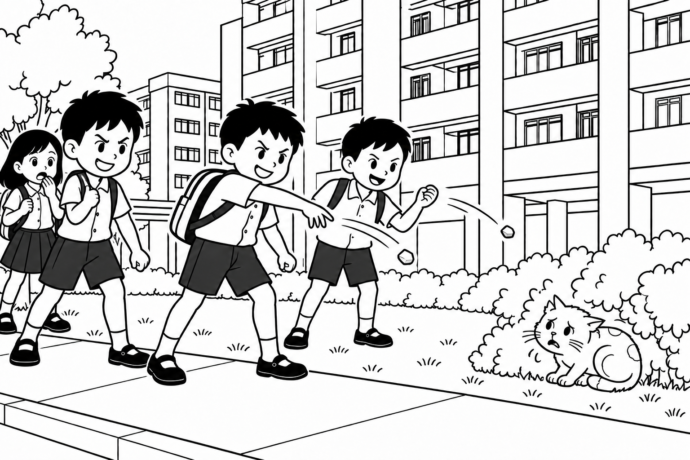
Just then, I was horrified when I spotted three boys pelting stones at a stray cat. It yowled in pain as it crouched beside a pillar. I was sickened by the sight and thought, “I must stop them!”
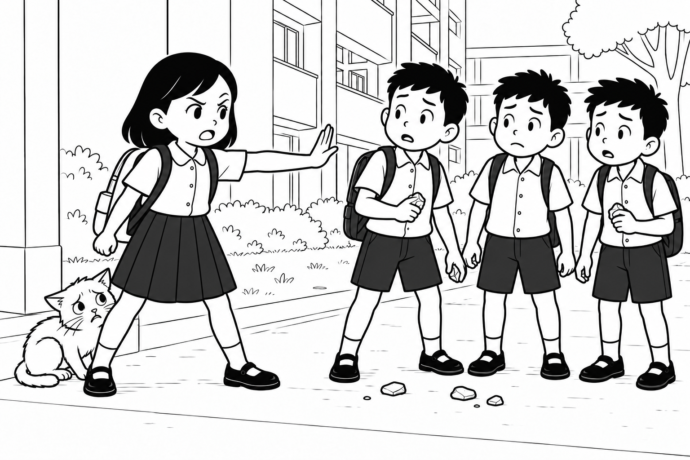
Immediately, I indignantly confronted the boys and ordered them to stop. “Stop bullying the cat!” I ordered them.
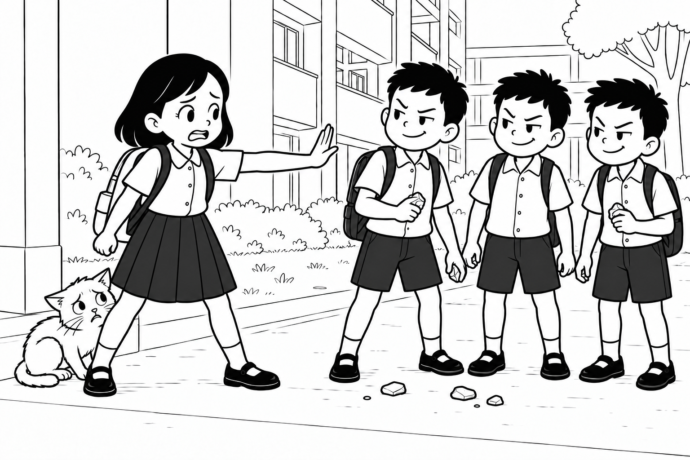
However, they merely smirked at me and shooed me away.
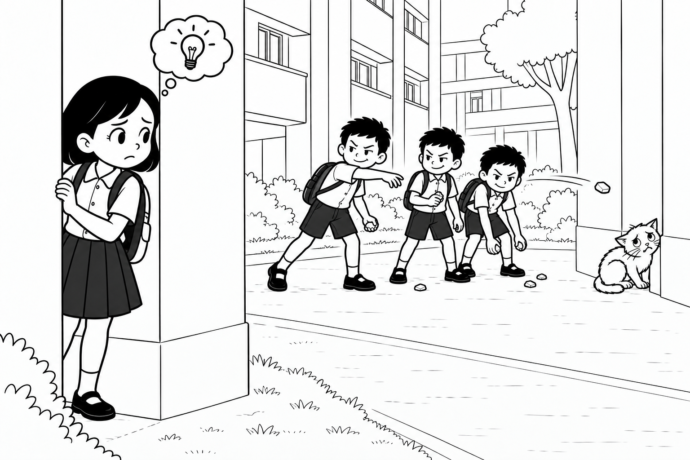
Feeling uneasy, I backed away and hid behind a pillar while I thought of a plan.
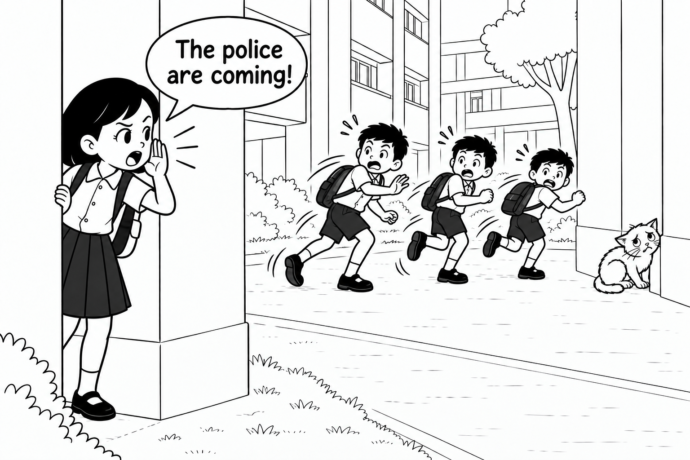
Suddenly, an idea popped into my mind. I yelled that the police were coming. The boys turned tail and fled. I punched the air as I thought, “It worked!”
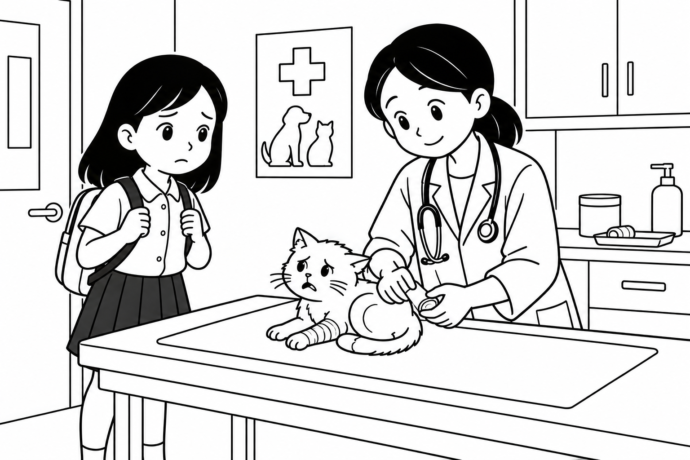
Relieved, I darted forward and gently scooped up the trembling cat. “You are safe now,” I murmured. When I noticed a small wound on its leg, I was concerned and decided to bring it to a vet at once.
Model of a Primary 3 Composition Main Event with the Feelings, Thoughts and Speech
Just then, I was horrified when I spotted three boys pelting stones at a stray cat. It yowled in pain as it crouched beside a pillar. I was sickened by the sight and thought, “I must stop them!” Immediately, I indignantly confronted the boys and ordered them to stop. “Stop bullying the cat!” I ordered them. However, they merely smirked at me and shooed me away. Feeling uneasy, I backed away and hid behind a pillar while I thought of a plan. Suddenly, an idea popped into my mind. I yelled that the police were coming. The boys turned tail and fled. I punched the air as I thought, “It worked!” Relieved, I darted forward and gently scooped up the trembling cat. “You are safe now,” I murmured. When I noticed a small wound on its leg, I was concerned and decided to bring it to a vet at once.
Practising these details can help pupils develop clearer, more engaging stories. Find out more about our Primary 3 English tuition programme and Primary 4 English tuition programme. For focused writing practice during the school holidays, see our Primary English holiday programme.


