Understanding the Primary 5 Present Perfect and Past Perfect Tense is essential for success in English grammar examinations. Many Primary 5 pupils find these tenses confusing because both refer to actions in the past. However, each tense serves a different purpose and is frequently tested in school assessments and PSLE-style grammar questions.
In this guide, we explain the differences between the Present Perfect Tense and Past Perfect Tense, provide examples, highlight common mistakes and include examination-style questions for practice.
Students who require additional grammar support may also benefit from our Primary 4 English tuition, Primary 5 English tuition and Primary 6 English tuition programmes, where grammar concepts are taught systematically and reinforced through guided practice.
What is the Present Perfect Tense?
The Present Perfect Tense is used to describe:
- An action that happened at an unspecified time in the past.
- An action that started in the past and continues until the present.
- A past action that has a result or effect in the present.
Structure of the Present Perfect Tense
Subject + has/have + past participle
Examples:
- Sarah has completed her homework.
- The boys have eaten their lunch.
- We have lived in this neighbourhood for five years.
Structure of the Past Perfect Tense
Subject + had + past participle
Examples:
- The train had left before we arrived at the station.
- She had completed her work before dinner.
- They had gone home when the rain started.
Understanding the Sequence of Events
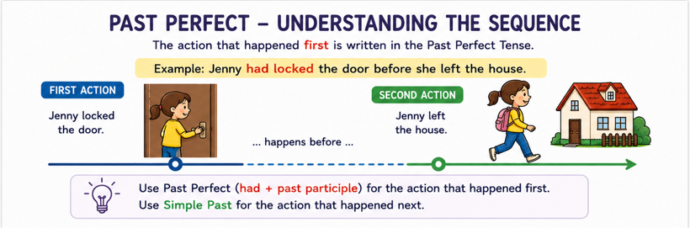
The action that happened first is written in the Past Perfect Tense.
Example:
- Jenny had locked the door before she left the house.
First action: Jenny locked the door.
Second action: Jenny left the house.
Therefore, had locked is used.
Why Do Students Confuse Present Perfect and Past Perfect Tense?
Many pupils struggle with Present Perfect and Past Perfect Tense because both tenses describe actions that happened in the past.
The key difference is that the Present Perfect Tense connects a past action to the present, while the Past Perfect Tense describes an action that happened before another action in the past.
A useful strategy is to look for time clues such as since, for, already, before, after and by the time. These keywords often indicate which tense should be used.
Students who are building stronger grammar foundations may also find our Primary 4 English tuition programme useful. For pupils preparing for upper primary examinations, our Primary 5 English tuition and Primary 6 English tuition programmes provide structured grammar, comprehension and composition training.
Present Perfect vs Past Perfect Tense
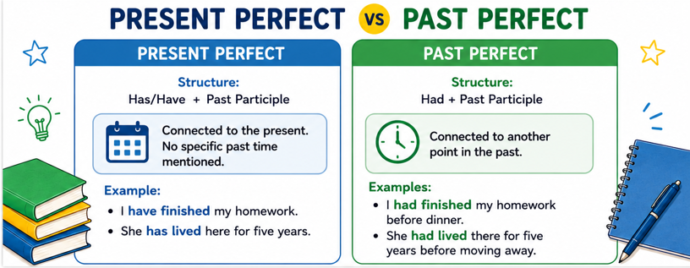
| Present Perfect | Past Perfect |
|---|---|
| Has/Have + Past Participle | Had + Past Participle |
| Connected to the present | Connected to another point in the past |
| I have finished my homework. | I had finished my homework before dinner. |
| She has lived here for five years. | She had lived there for five years before moving awa |
Primary 5 Present Perfect and Past Perfect Tense Practice Questions
Question 1
I have not seen my cousins who ___________ in Australia since five years ago.
(1) live
(2) lived
(3) had lived
(4) have lived
✅ Answer: (4) have lived
The sentence refers to an action that began in the past and is still continuing in the present.
Question 2
If you _________ work on your project earlier, you would have been able to complete it on time.
(1) begin
(2) began
(3) had begun
(4) have begun
✅ Answer: (3) had begun
The action happened earlier in the past and was completed before the second action.
Question 3
By the time Max and Pete reached the stadium, the football match ____________.
(1) started
(2) starts
(3) have started
(4) had started
✅ Answer: (4) had started
The match started before Max and Pete reached the stadium.
Question 4
Mr Lim’s knowledge of the latest technology __________ him in his work since he joined the company.
(1) helps
(2) helped
(3) has helped
(4) have helped
✅ Answer: (3) has helped
His knowledge continues to help him from the time he joined the company until now.
Common Grammar Errors Made by Primary 5 Students
Error 1: Using Present Perfect with a Specific Past Time
❌ I have visited Japan last year.
✅ I visited Japan last year.
Error 2: Forgetting to Use the Past Participle
❌ She has eat her lunch.
✅ She has eaten her lunch.
Error 3: Using Simple Past Instead of Past Perfect
❌ The movie started before we arrived.
✅ The movie had started before we arrived.
Error 4: Confusing “Has” and “Have”
❌ The boys has completed the task.
✅ The boys have completed the task.
❌ Sarah have completed the task.
✅ Sarah has completed the task.
Frequently Asked Questions About Present Perfect and Past Perfect Tense
The Present Perfect Tense connects a past action to the present. The Past Perfect Tense describes an action that happened before another action in the past.
Look for the structure:
Has/Have + Past Participle
Examples include:
- has completed
- have eaten
- have lived
Look for the structure:
Had + Past Participle
Examples include:
- had left
- had finished
- had started
Both Present Perfect Tense and Past Perfect Tense are commonly tested in grammar MCQs, editing exercises and synthesis questions.
Quick Tips for Present Perfect and Past Perfect Tense
Remember:
Present Perfect Tense
Has/Have + Past Participle
- Connected to the present.
- No specific past time is mentioned.
Past Perfect Tense
Had + Past Participle
- One action happened before another action in the past.
When you see two past actions in a sentence, ask yourself:
“Which action happened first?”
The action that happened first is usually written in the Past Perfect Tense.
Mastering Primary 5 Present Perfect and Past Perfect Tense
The Primary 5 Present Perfect and Past Perfect Tense are important grammar topics that pupils must understand well. Remember that the Present Perfect Tense connects an action to the present, while the Past Perfect Tense is used when one action happened before another action in the past.
Regular practice with examples and examination-style questions will help pupils recognise the correct tense quickly and avoid common mistakes.
Looking for more grammar support? Explore our Primary 4 English tuition, Primary 5 English tuition and Primary 6 English tuition programmes for systematic grammar instruction, comprehension strategies and composition writing guidance.


