Primary 3 grammar in Singapore becomes more challenging as children move beyond the lower primary years. Grammar is no longer tested only in standalone exercises—it plays an important role in editing, comprehension, situational writing and composition. If your child continues to lose marks despite understanding grammar rules, our Primary 3 English tuition in Singapore focuses on helping pupils apply grammar accurately in editing, comprehension and composition.
Many grammar mistakes seen in Primary 3 actually begin much earlier. Building a strong foundation through Primary 2 English tuition can make the transition to Primary 3 significantly smoother. At CreativEdge Learning, we regularly help pupils strengthen their Primary 3 grammar skills by addressing the mistakes that appear most frequently in schoolwork and examinations. The good news is that these errors are common, and with consistent practice and timely feedback, they can be corrected.
Below are eight of the most common Primary 3 grammar mistakes made by pupils in Singapore and practical tips to help your child avoid them.
1. Subject-Verb Agreement
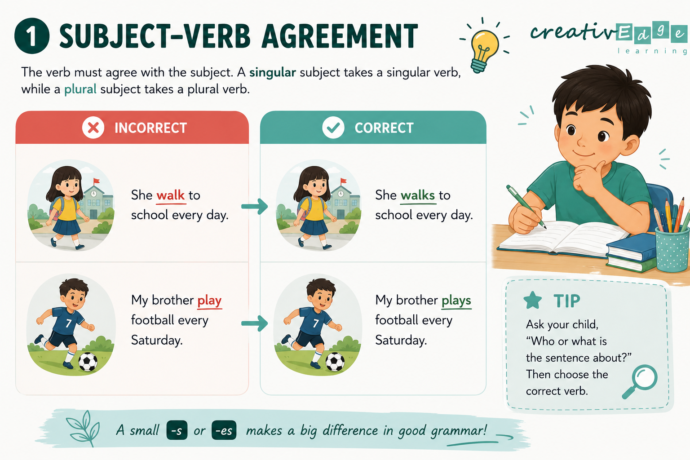
Subject-verb agreement is one of the most frequently tested Primary 3 grammar topics.
Incorrect
- She walk to school every day.
- My brother play football every Saturday.
Correct
- She walks to school every day.
- My brother plays football every Saturday.
A singular subject usually takes a singular verb, while a plural subject takes a plural verb. Children often forget to add -s or -es to verbs when writing about one person or one thing.
Tip: Ask your child to identify the subject first before deciding which verb to use.
2. Confusing Is, Are, Was and Were
Many Primary 3 pupils confuse the present and past forms of the verb “to be”.
Incorrect
- The boys was playing football.
- Yesterday, I am late for school.
Correct
- The boys were playing football.
- Yesterday, I was late for school.
A simple reminder can help:
- is – one person or thing (present)
- are – more than one (present)
- was – one person or thing (past)
- were – more than one (past)
Mastering these forms is an important part of building strong Primary 3 grammar skills.
As these verbs are the basic building blocks the writing of sentence, children should start learning these verbs as early as possible hence our Primary 1 tuition class introduces and reinforces these verbs.
3. Mixing Up Countable and Uncountable Nouns
Many pupils use the wrong quantifiers because they are unsure whether a noun can be counted. Often, they use the wrong quantifiers for special words such as homework and food.
Incorrect
- many water
- much pencils
- many food
- many homework
Correct
- much water
- many pencils
- some or much food
- some or much homework
Reading widely helps children become more familiar with natural English usage and improves their grammar over time.
4. Mixing Tenses
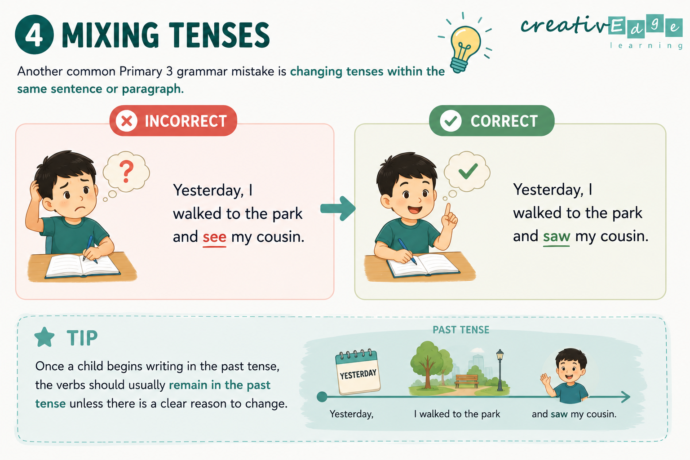
Another common Primary 3 grammar mistake is changing tenses within the same sentence or paragraph.
Incorrect
Yesterday, I walked to the park and see my cousin.
Correct
Yesterday, I walked to the park and saw my cousin.
Once a child begins writing in the past tense, the verbs should usually remain in the past tense unless there is a clear reason to change.
Another common Primary 3 grammar mistake is changing tenses within the same sentence or paragraph.
Incorrect
Yesterday, I walked to the park and see my cousin.
Correct
Yesterday, I walked to the park and saw my cousin.
Once a child begins writing in the past tense, the verbs should usually remain in the past tense unless there is a clear reason to change.
5. Using the Wrong Prepositions
Prepositions can be difficult because many expressions simply have to be learnt through regular exposure to English.
Incorrect
- We arrived in the bus stop.
- She sat at the chair.
Correct
- We arrived at the bus stop.
- She sat on the chair.
Regular reading and guided correction help children develop a natural sense of which prepositions sound correct.
Why Primary 3 Grammar Matters
Strong Primary 3 grammar skills benefit children far beyond grammar worksheets.
A solid understanding of grammar helps pupils:
- write complete and accurate sentences
- perform better in editing exercises
- improve comprehension accuracy
- express ideas more clearly in composition
- communicate more confidently during oral examinations
When grammar becomes automatic, children can focus on generating ideas instead of worrying about sentence construction.
How We Teach Primary 3 Grammar at CreativEdge Learning
At CreativEdge Learning, we believe children learn Primary 3 grammar best when they apply grammar in meaningful contexts instead of memorising rules in isolation.
Our lessons reinforce grammar through:
- editing exercises
- guided sentence construction
- vocabulary development
- comprehension practice
- composition writing
- regular revision and personalised feedback
Rather than completing endless grammar worksheets, pupils learn how grammar supports every component of the English examination. This enables them to recognise mistakes independently and apply grammar confidently in their own writing.
New to CreativEdge Learning? Our Primary 3 Discovery Programme allows pupils to experience our teaching approach before enrolling for regular lessons. It is an excellent opportunity to strengthen grammar foundations while becoming familiar with our classroom environment.
Frequently Asked Questions
What Primary 3 grammar topics should children in Singapore know?
The Primary 3 grammar syllabus in Singapore typically includes subject-verb agreement, tenses, articles, pronouns, conjunctions, prepositions, singular and plural nouns, punctuation and sentence structure. These topics are assessed through grammar exercises, editing, comprehension and composition.
Why does my child keep making the same grammar mistakes?
Many children understand grammar rules during lessons but forget to apply them when writing independently. Regular practice, constructive feedback and opportunities to use grammar in authentic writing help children develop lasting habits.
Is Primary 3 grammar important for composition?
Yes. Grammar affects sentence accuracy, clarity and overall writing quality. Even when pupils have excellent ideas, frequent grammar mistakes may reduce their marks in composition and situational writing.
How can parents improve their child’s Primary 3 grammar?
Parents can encourage regular reading, discuss grammar mistakes made in schoolwork and remind children to review corrections carefully. Consistent practice is generally more effective than completing large numbers of worksheets without feedback.
Final Thoughts
Mastering Primary 3 grammar in Singapore gives children a strong foundation for success in English. By correcting common grammar mistakes early, pupils become more confident writers and are better prepared for the increasing language demands of upper primary and, eventually, the PSLE.
If your child frequently loses marks because of grammar mistakes despite understanding the rules, focused guidance and consistent practice can make a significant difference. Developing strong Primary 3 grammar skills today will support your child’s progress in editing, comprehension, composition and every stage of their English learning journey.


