Is your child struggling with Primary 6 composition or unsure how to write a compelling turning point story for the PSLE English exam?
Many students lose marks not because they lack ideas, but because they do not know how to structure their story or develop a meaningful change in the character.
In this guide, you’ll learn exactly how to write a high-scoring turning point composition, common mistakes to avoid, and practical techniques your child can apply immediately.

What Is a Primary 6 Composition Turning Point Story?
A turning point is a key moment in a story where everything changes.
In PSLE English composition, this is the most important part of the story. It is the moment that:
- Changes the direction of the story
- Forces the main character to reflect
- Leads to a clear change in behaviour or attitude
Without a strong turning point, the story often feels flat—and this is where many students lose marks.

What Is a Turning Point Story?
A turning point story is a type of Primary 6 composition where the main character undergoes a meaningful transformation.
Typically, the story follows this structure:
- Beginning: The character displays negative behaviour (e.g. careless, selfish, dishonest)
- Middle (Turning Point): A significant event happens that forces reflection
- Ending: The character changes for the better
👉 Examiners are not just looking for a story—they are looking for a clear lesson and believable character development.
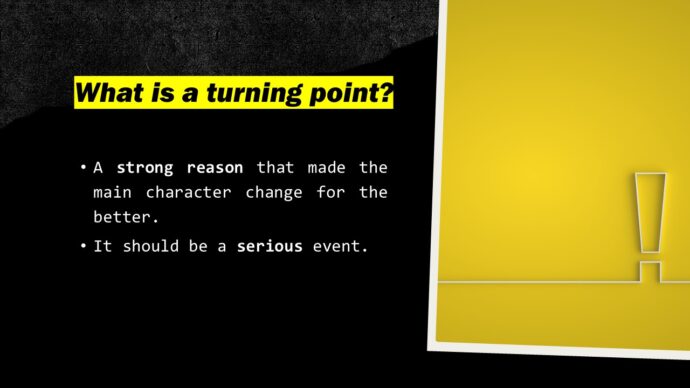
A turning point is the time at which a situation starts to change in an important way.
This means that when writing a Primary 6 English composition, there must be an important scene in the middle of the story which changes the direction of the story.
Generally, it should be a serious event. This event will then provide a strong reason for the main character’s complete change of behaviour and attitude.
Primary 6 Composition Turning Point Story Structure (Step-by-Step Guide)

1. Start with a Clear Problem
Introduce the main character’s weakness early.
Examples:
- Careless with responsibilities
- Disrespectful towards others
- Unwilling to admit mistakes
👉 This sets up the story and makes the final change more impactful.
2. Build Towards the Turning Point
Create tension leading up to the key event.
You can do this by:
- Showing consequences of the character’s behaviour
- Introducing conflict (with friends, teachers, or family)
3. Develop a Strong Turning Point (Most Important)
This is where most students lose marks.
A good turning point should:
- Be serious and meaningful (not something trivial)
- Be written as a detailed scene (not rushed in 2–3 lines)
- Trigger strong emotions (shock, guilt, fear, regret)
👉 This section should be the longest and most detailed part of the composition.
4. Show a Clear Positive Change
After the turning point, the character must:
- Reflect on what happened
- Realise their mistake
- Take action to change
⚠️ Common mistake:
Students write “He promised to change” but show no actual change.
Instead, describe:
- What the character did differently
- How others reacted
- How the situation improved
5. End with a Meaningful Conclusion
A strong ending should:
- Reinforce the lesson learned
- Show lasting change
- Feel natural (not forced)
Which parts of the story to emphasize?
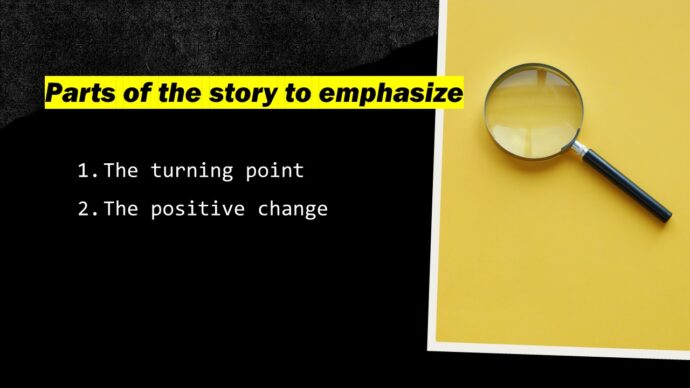
When writing a Primary 6 composition, it is vital to know that writing more is not always better.
To score in the PSLE composition exam, the writing should place emphasis on the parts of the story which convey a positive meaning and lesson.
- The turning point – The event which changed the main character must be described in detail as one complete scene.
- The positive change – The story should describe in detail how the main character changed for the better. This means writing in detail exactly what he did that showed that he changed for the better (1 to 2 paragraphs).
Common Mistakes in Primary 6 Composition Turning Point Story Writing
Many students struggle with Primary 6 composition because of these issues:
❌ Weak or unrealistic turning point
The event is too minor to justify a big change.
❌ Rushed story development
The turning point and ending are too short.
❌ No clear character change
The story ends without showing improvement.
❌ Overwriting irrelevant details
Students write long introductions but neglect key moments.
FAQs on Primary 6 Composition
Focus on a clear structure, a strong turning point, and a well-developed character change.
The turning point—it determines the overall impact of the story.
A meaningful lesson, realistic events, and detailed storytelling.
Helping Your Child Excel in PSLE English Composition
If your child struggles with generating ideas or writing impactful compositions, consistent guidance makes a significant difference.
At our centre, we focus on:
- Step-by-step composition structures
- Real exam-based strategies
- Detailed feedback to improve quickly
Explore our:
- Primary 5 English Tuition Programme (build strong foundations early)
- Primary 6 English Tuition Programme (focused PSLE preparation)
Our lessons are designed to help students:
- Write with clarity and confidence
- Develop strong ideas independently
- Achieve higher scores in PSLE English
Final Tip
A high-scoring turning point composition is not about writing more—it’s about writing with purpose, structure, and impact.
When students master this, their results improve quickly—and more importantly, they gain confidence in their writing.


No Responses